An innovation of the ‘Institute for the Study and Promotion of Medicinal and Aromatic Plants (In.ΜAP) – Agricultural University of Athens
The Institute for the Study and Promotion of Medicinal and Aromatic Plants announces the establishment of the cultivation of “Arethousa,” the first certified Greek oregano variety.
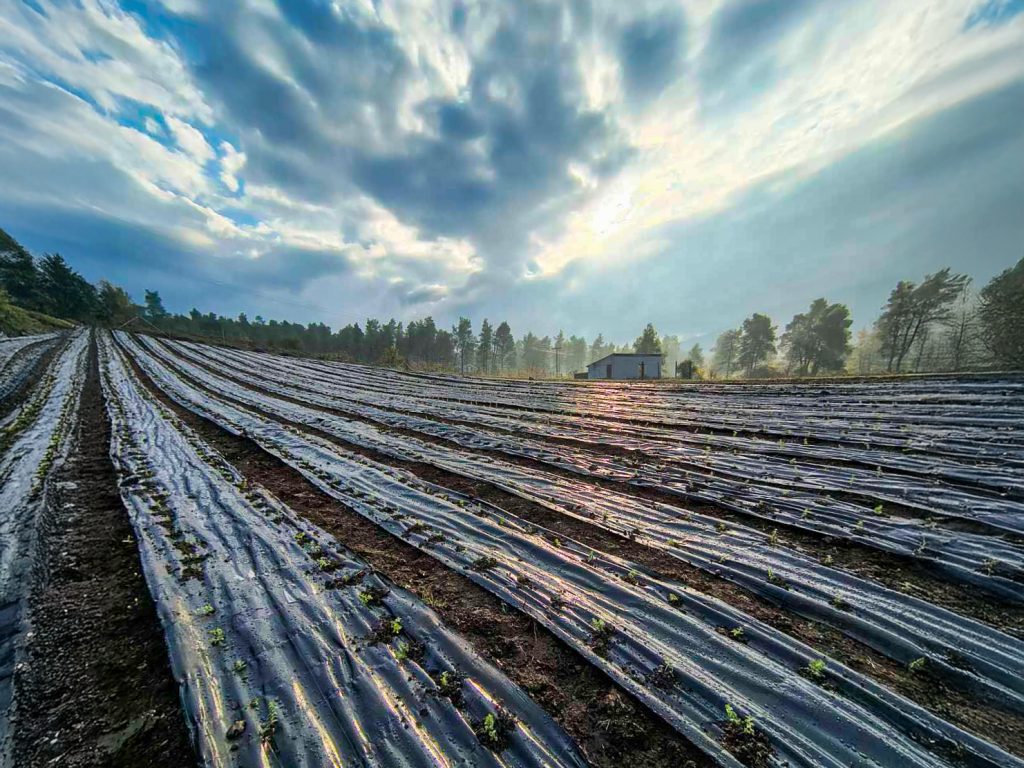
The cultivation has been established in Northern Evia, in the Municipality of
Mantoudi–Limni–Agia Anna, by producer and agronomist K. Kentepozidis, a postgraduate student at the Agricultural University of Athens (AUA).
This initiative was carried out within the framework of collaboration between the AUA and the organic nursery BIOMA. The variety “Arethousa” is the outcome of a long term research conducted by In. MAP – AUA, highlighting a significant milestone in the development and promotion of Greek medicinal and aromatic plants. “Arethousa” is registered in the National Catalogue of Cultivated Plant Varieties of the Ministry of Rural Development and Food, as well as with the Community Plant Variety Office (CPVO – A202303129), and is currently in the process of obtaining European-level Intellectual Property Rights.
The development of the variety was based on an integrated scientific, institutional, entrepreneurial, and legal approach, aiming at the production of certified organic propagation material that is botanically and chemotypically controlled, the sustainable cultivation and processing of final products, and their successful commercial exploitation, with quality assurance provided by the Institute.
Agricultural University of Athens innovates by introducing to the market, for the first time, a controlled and certified Greek oregano variety, strengthening Greek identity and enhancing the competitiveness of Medicinal and Aromatic Plants in both national and international markets.
What are the distinguishing characteristics that set Arethousa apart from standard
commercial propagation material?
The genetic stability and chemotypic identity differentiates “Arethousa” from the a typical propagating material currently circulating on the market
Arethousa stands out compared to the atypical propagating material currently circulating on the market due to the stability of its quantitative and qualitative characteristics. Specifically, long-term research conducted by the Institute’s research team since 2008—when it was identified in Arethousa, Ikaria—demonstrated its high adaptability across all environments in which it was tested. The study results showed that Arethousa consistently yields over 10% essential oil from the second year of its cultivation, while the percentage concentration of its
main active constituent, carvacrol, is detected at average levels above 87%.
Registration in the National Catalogue and the CPVO creates a new institutional
framework.
The innovation of a new variety is protected.
Standardization and quality are secured.
Creation of a competitive advantage. In countries with rich biodiversity such as Greece,
this can transform endemic populations into premium commercial products.
Given climate variability, the adaptability and efficiency of “Arethousa” across
different soil and climatic zones of the country are high.
It is a variety that, according to our studies, is unaffected by climate variation across the different regions where it has been tested. Specifically, it has been evaluated through research within the framework of a Doctoral Dissertation in Ikaria, at the Agricultural University of Athens (AUA) farm in Spata, at the AUA Agronomy Laboratory farm, in Milos, at the AUA farm in Kopais, and in Aridaia at the BIOMA – Biological Nursery company farm, spanning a wide range of climates from intensely xerothermic to intensely cold under conditions of prolonged frost. Under all conditions, it showed high resilience, successfully overcoming physiological stress without any significant impact on its quantitative and qualitative characteristics.
The quality, traceability and control of the propagating material ensures in
practice the credibility of the variety on the market.
Through the establishment of a “guaranteed mother plantation” for the production of propagating material.
The implementation of controls ensures the botanical and chemotypic uniformity of the mother plantation.
The development of appropriate compliance requirements for propagating material production units (nurseries) can reliably support proper propagation techniques for MAPs (Medicinal and Aromatic Plants).
Although Greek oregano is already internationally recognized, “Arethousa”
fundamentally changes the producer’s level of bargaining power and the country’s
positioning in international markets.
Featuring stable quality, a specific chemical profile, and distinctive characteristics, the
product becomes a recognized cultivar (variety) rather than simply “Greek oregano”,
thus positioning the country in the global market.
Cultivating a certified variety offers specific and rare genetic material, allowing
participation in contract farming and the negotiation of a premium price.
Major markets (pharmaceuticals, cosmetics, natural products) demand: stable active ingredient content, traceability, and standardized raw materials.
A variety like Arethousa can serve as a standardized raw material—something that “generic oregano” cannot always guarantee.
Αφήστε μια απάντηση